
Connexient started with one simple question: why can't we have Indoor GPS?
Addressing that required understanding and solving challenges that spanned technology innovation, extraordinary UI/UX demands, user behaviors and adoption, and matching product capabilities to the real-world needs and expectations of large enterprise customers.
Along this journey we achieved something that even Google and Apple have still yet to reach: true turn-by-turn indoor navigation in highly complex and scaled indoor facilities.
The Problem
My client, GDS, Inc. had a successful business providing "wayfinding" signage for hospitals in the Northeast of the US. Their clients spent hundreds of thousands of dollars to design & install — and tens of thousands annually to maintain — signage systems to help patients find their way. Yet over 85% of patients still got lost, resulting in poor patient experience, missed appointments, distracted staff and overhead. So my client asked: "Why can't we have indoor GPS?" This was a clear pain point and business opportunity — but solving it presented numerous deep challenges.
- 01Indoor Mapping. Nobody had ever mapped buildings of the scale & complexity of major hospitals and healthcare campuses.
- 02Indoor Positioning. There were no solutions for accurate, real-time indoor positioning at the time.
- 03User Expectations. Everyone uses Google or Apple navigation, so UX expectations were very high — with no roads, exit numbers or city destinations to leverage indoors.
- 04Business Model & GTM. How do you get a large enterprise to pay for something never done before that can't be proven until deployed at scale in their buildings?
- 05Capital Constraints. My clients wanted to minimize outside capital and bootstrap the business on revenues as much as possible.
The Solution: MediNav
I designed and developed both the product and go-to-market strategy for MediNav, pioneering a new space for Indoor Mapping & Navigation. The key was to leverage the value, priority — and budgets — that healthcare networks were just starting to place on "Patient Experience," encapsulated in the new role of Chief Patient Experience Officer.
How We Solved the Technical & Product Challenges
1. Indoor Mapping
We evaluated many approaches — building our own platform, Google Maps with custom JavaScript, and over a dozen indoor mapping companies — ultimately partnering with Visioglobe and pushing the technology, process and UX forward to meet the demanding requirements of navigation, not just mapping.
2. Indoor Positioning
A thorny challenge: in 2013 enterprise WiFi offered 10–15m accuracy and 30s+ refresh. We collaborated with Cisco for years, then spotted the potential of Bluetooth Low Energy beacons at the end of 2013 — leading to a long, productive partnership with Polestar to advance accuracy, refresh and large-scale deployment.
3. User Expectations for Navigation
Users inevitably compared indoor to Google/Apple outdoor navigation — a very high bar, with no road-like structure, few recognizable visual cues, and large open lobbies and atriums that are especially hard environments in which to orient and navigate.
4. Business Model & GTM
The product and GTM strategy let us sell an unproven product into risk-averse enterprises by leveraging existing facilities budgets with a new focus on Patient Experience — addressing one of the most important pain points of every arriving patient.
5. Capital Constraints
Long-term contracts with up-front deployment payments eased capital constraints. We built the company and took it to exit with less than $3M of equity capital over seven years.
The Results
We delivered the first true turn-by-turn indoor navigation that could guide users through enormous, complex, maze-like facilities. Our all-screens, indoor + outdoor capabilities and enterprise roadmap positioned us to work with clients as partners over the long term.
MediNav Feature Spotlight
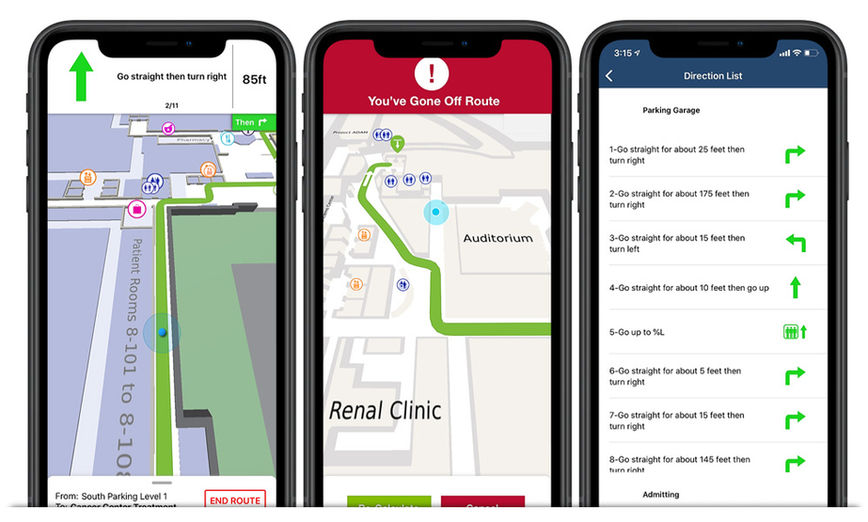
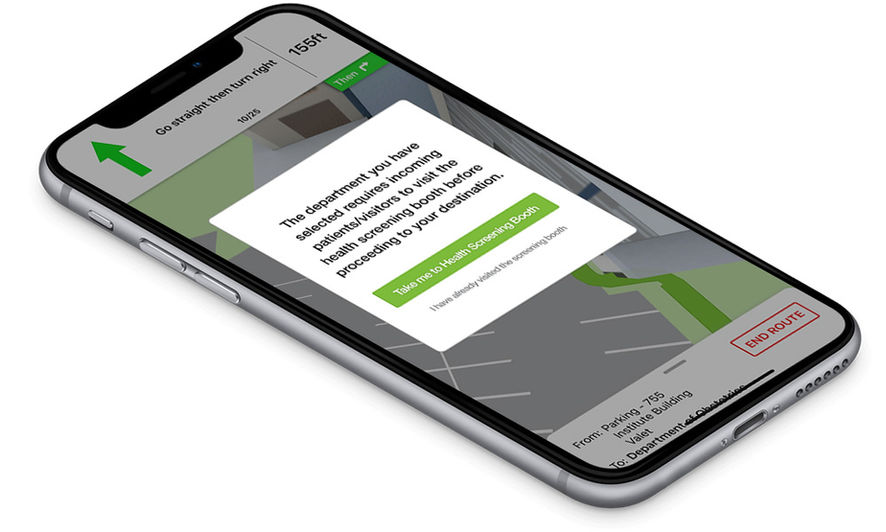
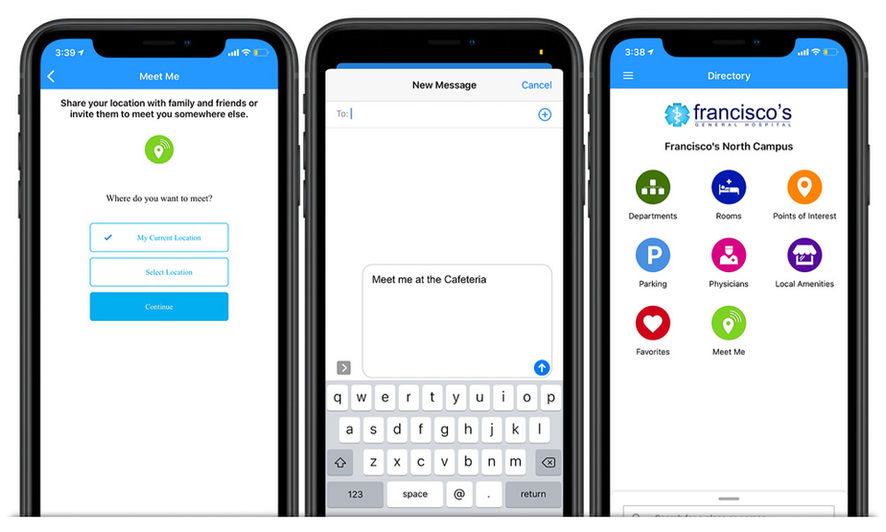
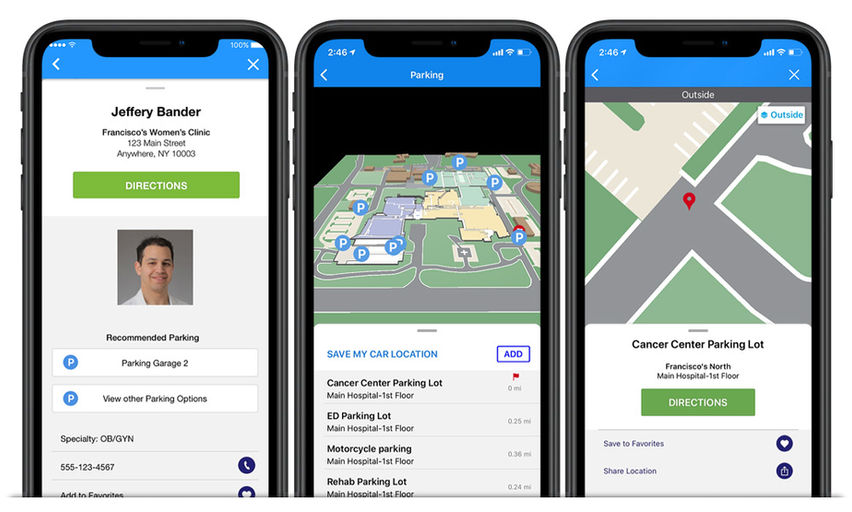
Integrates with EHR systems and appointment-scheduling apps. The location engine is compatible with all leading location infrastructures (Cisco, Centrak, Mist/Juniper, Siemens/Enlighted, HP/Aruba, and more), delivered through MapKit, LocationKit, CMSKit and AnalyticsKit modules.